Dentalverse
Dentalverse
Explore Features
Tooth Atlas
52 teeth mapped
Drug Reference
27 medications
Anesthesia Guide
11 anesthetic agents
Clinical Procedures
135 step-by-step
Tomorrow's Clinic
Prep sheets & day planner
Medical Conditions
83 conditions
Clinical Thinking
40 case simulations
Clinical Mistakes
105 common errors
Video Library
Curated by specialty
INBDE Prep
3,386 study cards
AI Study Tools
Teach Me, Quiz, Chat
View all features
LibraryPodcastBlogPricingFAQLog inTry Free
All articles
Pediatric Dentistrybehavior managementtell-show-dochild anxiety

How to Use Tell–Show–Do Without Losing the Child's Trust (A Basic Behavior Guidance Guide)

Tell–Show–Do and the six basic guidance techniques: the 60-second triage, the no-surprise rule, and knowing when to stop — a dental student's guide.

D
Dr. Saleh Albakri
July 13, 2026
3 min read

Every pediatric appointment is won or lost before you pick up an instrument. A stainless steel crown, a pulpotomy, even a simple prophy — none of it happens if the child won't let it happen. Behavior guidance is the skill that gets you there, and like any clinical skill, it can be drilled and done well.

Why Tell–Show–Do works — and why it's easy to break

Kill the myth that this is about "being good with kids." Behavior guidance is a planned set of communication and clinical techniques — lower fear, build trust, gain cooperation, deliver safe care — governed by one AAPD rule: start basic with essentially every child, and step up only if actually needed, in small reversible steps.

Before you say a word about teeth, you're reading three things: the child (development, prior experience, anxiety), the parent — nervous parents transmit anxiety directly to the child — and the procedure; a quick fluoride application and a long restoration make completely different demands on a five-year-old. Sixty seconds of reading saves thirty minutes of fighting.

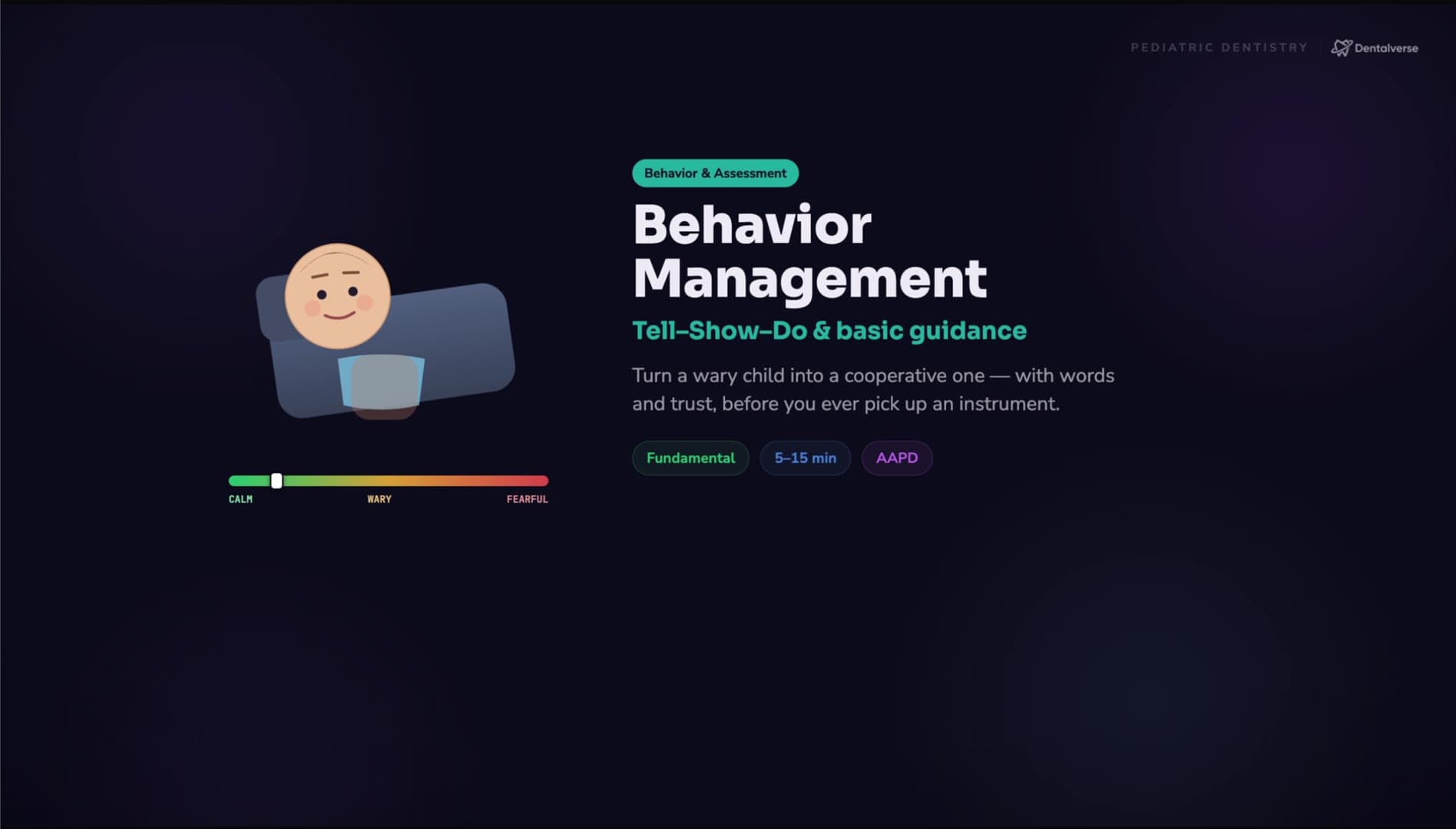
Tell–Show–Do is the opening move, with a property almost nothing else in dentistry has: any patient, no contraindications. The mental model is a contract. Tell the child what will happen in child-safe language, show it on something safe before it goes near the mouth, then do exactly what you demonstrated. The golden rule: never surprise the child after Show. "Do" is identical to "Show" — the child has already lived it once, safely. Break that contract and you may lose the child for the visit.

TSD is the opener, not the whole game — a wider basic toolkit (positive reinforcement, distraction, desensitization, nonverbal cues, voice control) is matched to the child's behavior. When movement becomes unsafe, stop: deferral is a legitimate, professional outcome, not a failure.

Key takeaways

  • Behavior guidance is a planned, drillable clinical skill: start basic with every child and escalate only in small, reversible steps.
  • Tell–Show–Do has no contraindications — but it lives or dies on never surprising the child after Show.
  • Read the child, the parent, and the procedure first; parental anxiety transmits straight to the child, and "unsafe" always means stop.

Learn the full protocol

This summary is the mental model; the complete walkthrough is in Dentalverse. The narrated video lesson, the step-by-step protocol with armamentarium and pitfalls, and the night-before prep sheet are all on [the reference page](/explore/procedures/behavior-management-techniques-tell-show-do-basic-guidance). [Start free](/signup) to study it properly.

This article is a study aid for dental students, not medical advice — always follow your institution's protocols and current guidelines.

Inside the app

Put this into practice inside Dentalverse

Every concept in this article is backed by interactive reference material, AI tools, and practice questions.

Tooth Atlas
Tooth #14
Maxillary Left 1st Molar
Roots3 (MB, DB, P)
Canals3–4 (MB2 common)
InnervationPSA nerve
BlockPSA injection
Tooth Atlas→
Drug Reference
AntibioticPenicillin
Amoxicillin
First-line for odontogenic infections
Adult dose
500 mg PO every 8 hours
Prophylaxis (AHA)
2 g PO, 30–60 min pre-op
Contraindication
Penicillin allergy
Drug Reference→
Clinical Case
HR 80
45 min
$520
Turn 2 of 4
A 62-year-old presents with severe pain on tooth #30. BP 148/92. Takes warfarin for AFib.
Next step
Order INR before extraction
Extract immediately
Refer to physician
Clinical Cases→
INBDE Prep
PharmacologyCard 47 / 120
Question
What is the max recommended dose of 2% lidocaine with 1:100,000 epi in a healthy adult?
A3.0 mg/kg
B4.4 mg/kg
C7.0 mg/kg
D10 mg/kg
INBDE Prep→
Procedures
Operative
Class II Composite
8 steps · 30-45 min
1
Anesthesia + isolation
2
Caries removal
3
Matrix + wedge placement
4
Etch + bond
5
Incremental fill
Procedures→
AI Study Chat
When do I prescribe antibiotic prophylaxis for a prosthetic joint patient?
Dentalverse AI
Per the 2015 ADA guideline, routine antibiotic prophylaxis is generally not recommended for prosthetic joint patients. Consult the orthopedic surgeon for high-risk individuals.
ADA 2015JADA
AI Chat→

Continue reading

Ectopic Eruption of the First Permanent Molar: When to Observe, Intercept, or Refer

3 min read

Why You Never Replant a Primary Tooth (and Always Try to Save a Permanent One)

6 min read

How to Extract a Primary Tooth Safely — and Stop the Bleeding Before the Child Goes Home

3 min read

Ready to study smarter?

Sign up free and start studying smarter.

Try Free
Dentalverse

Your dental school companion from Day 1 through graduation. Built for dental students.

Features
Tooth AtlasDrug ReferenceAnesthesia GuideClinical ProceduresTomorrow's ClinicMedical ConditionsClinical ThinkingClinical MistakesVideo LibraryINBDE PrepAI Study Tools
Resources
Explore the LibraryPodcastBlogFAQContact Us
Legal
Privacy PolicyTerms of ServiceRefund PolicyCookie PolicyDisclaimerAI Use PolicyCommunity GuidelinesCopyright

© 2026 Denverse Ltd (Company No. 17146294). All rights reserved.

Educational platform only. Content is not medical or dental advice.