Dentalverse
Dentalverse
Explore Features
Tooth Atlas
52 teeth mapped
Drug Reference
27 medications
Anesthesia Guide
11 anesthetic agents
Clinical Procedures
135 step-by-step
Tomorrow's Clinic
Prep sheets & day planner
Medical Conditions
83 conditions
Clinical Thinking
40 case simulations
Clinical Mistakes
105 common errors
Video Library
Curated by specialty
INBDE Prep
3,386 study cards
AI Study Tools
Teach Me, Quiz, Chat
View all features
LibraryPodcastBlogPricingFAQLog inTry Free
All articles
Pediatric Dentistryectopic eruptioninterceptive orthodonticsmixed dentition

Ectopic Eruption of the First Permanent Molar: When to Observe, Intercept, or Refer

Spot the locked maxillary first molar early: screening ages, bitewing signs, the observe-vs-intercept tipping point, separators, and referral triggers.

D
Dr. Saleh Albakri
July 13, 2026
3 min read

A seven-year-old comes in for a routine recall. One maxillary first molar is fully erupted; the other is nowhere to be seen. If your instinct is "give it time," be careful — sometimes that missing molar isn't late, it's stuck, quietly chewing through the root of the tooth in front of it. Catching it early is one of the highest-value plays in mixed-dentition screening.

The mental model: one small change in angle, two very different outcomes

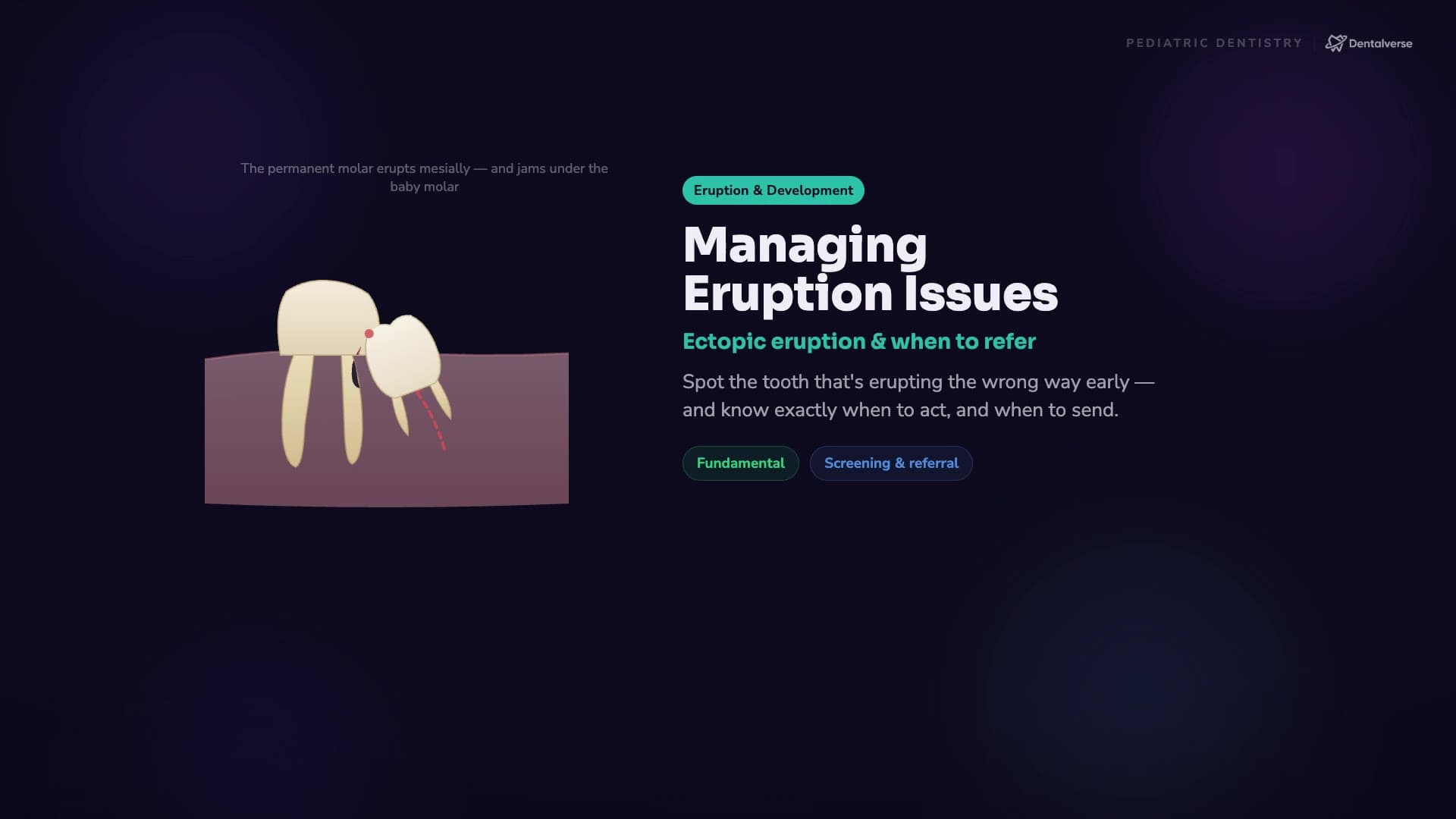
Ectopic eruption is a disturbance in which a permanent tooth follows an abnormal path and locks against a primary tooth. The classic presentation — worth burning into memory — is the maxillary first permanent molar erupting on a mesial angle and jamming under the distal surface of the primary second molar.

Picture the two paths. On a normal path the molar rises upright and clears the primary molar's distal height of contour; on the ectopic path it tips mesially, catches under the distal bulge, and resorbs the primary molar's distal root. Same tooth, one small change in angle — a completely different outcome.

The lock is easy to miss chairside; the damage is largely radiographic. First permanent molars erupt around ages six to eight, and the red flag is asymmetry — one side erupted, the other late. Often the routine bitewing taken for caries reveals the lock and the resorption together.

Left untreated, it cascades: early loss of the primary second molar, space loss, and eruption problems ahead. Every case comes down to one fork — observe or intercept — and the tipping point is progressive resorption. A minimally locked, self-correcting molar can be watched with a defined recall; a lock destroying the primary root cannot. Knowing where your role ends — when a case belongs with pediatric dentistry or orthodontics — is part of the skill.

Key takeaways

  • The classic pattern is the maxillary first permanent molar tipping mesially and locking under the primary second molar.
  • Asymmetric eruption around ages six to eight is the cue to image; the bitewing shows both the lock and the damage.
  • Progressive resorption is the tipping point between observing and intercepting — and observation always means a defined recall.

Learn the full protocol

The complete walkthrough lives inside Dentalverse: the narrated video lesson with the normal-vs-ectopic animation, the step-by-step protocol with armamentarium and pitfalls, and the night-before prep sheet. Start with [the reference page](/explore/procedures/management-of-eruption-issues-ectopic-eruption-referral), then [start free](/signup) to unlock it.

This article is a study aid for dental students, not medical advice — always follow your institution's protocols and your supervising clinician's guidance.

Inside the app

Put this into practice inside Dentalverse

Every concept in this article is backed by interactive reference material, AI tools, and practice questions.

Tooth Atlas
Tooth #14
Maxillary Left 1st Molar
Roots3 (MB, DB, P)
Canals3–4 (MB2 common)
InnervationPSA nerve
BlockPSA injection
Tooth Atlas→
Drug Reference
AntibioticPenicillin
Amoxicillin
First-line for odontogenic infections
Adult dose
500 mg PO every 8 hours
Prophylaxis (AHA)
2 g PO, 30–60 min pre-op
Contraindication
Penicillin allergy
Drug Reference→
Clinical Case
HR 80
45 min
$520
Turn 2 of 4
A 62-year-old presents with severe pain on tooth #30. BP 148/92. Takes warfarin for AFib.
Next step
Order INR before extraction
Extract immediately
Refer to physician
Clinical Cases→
INBDE Prep
PharmacologyCard 47 / 120
Question
What is the max recommended dose of 2% lidocaine with 1:100,000 epi in a healthy adult?
A3.0 mg/kg
B4.4 mg/kg
C7.0 mg/kg
D10 mg/kg
INBDE Prep→
Procedures
Operative
Class II Composite
8 steps · 30-45 min
1
Anesthesia + isolation
2
Caries removal
3
Matrix + wedge placement
4
Etch + bond
5
Incremental fill
Procedures→
AI Study Chat
When do I prescribe antibiotic prophylaxis for a prosthetic joint patient?
Dentalverse AI
Per the 2015 ADA guideline, routine antibiotic prophylaxis is generally not recommended for prosthetic joint patients. Consult the orthopedic surgeon for high-risk individuals.
ADA 2015JADA
AI Chat→

Continue reading

Why You Never Replant a Primary Tooth (and Always Try to Save a Permanent One)

6 min read

How to Extract a Primary Tooth Safely — and Stop the Bleeding Before the Child Goes Home

3 min read

How to Decide When a Child Needs a Space Maintainer (Band-and-Loop vs Lingual Arch)

3 min read

Ready to study smarter?

Sign up free and start studying smarter.

Try Free
Dentalverse

Your dental school companion from Day 1 through graduation. Built for dental students.

Features
Tooth AtlasDrug ReferenceAnesthesia GuideClinical ProceduresTomorrow's ClinicMedical ConditionsClinical ThinkingClinical MistakesVideo LibraryINBDE PrepAI Study Tools
Resources
Explore the LibraryPodcastBlogFAQContact Us
Legal
Privacy PolicyTerms of ServiceRefund PolicyCookie PolicyDisclaimerAI Use PolicyCommunity GuidelinesCopyright

© 2026 Denverse Ltd (Company No. 17146294). All rights reserved.

Educational platform only. Content is not medical or dental advice.