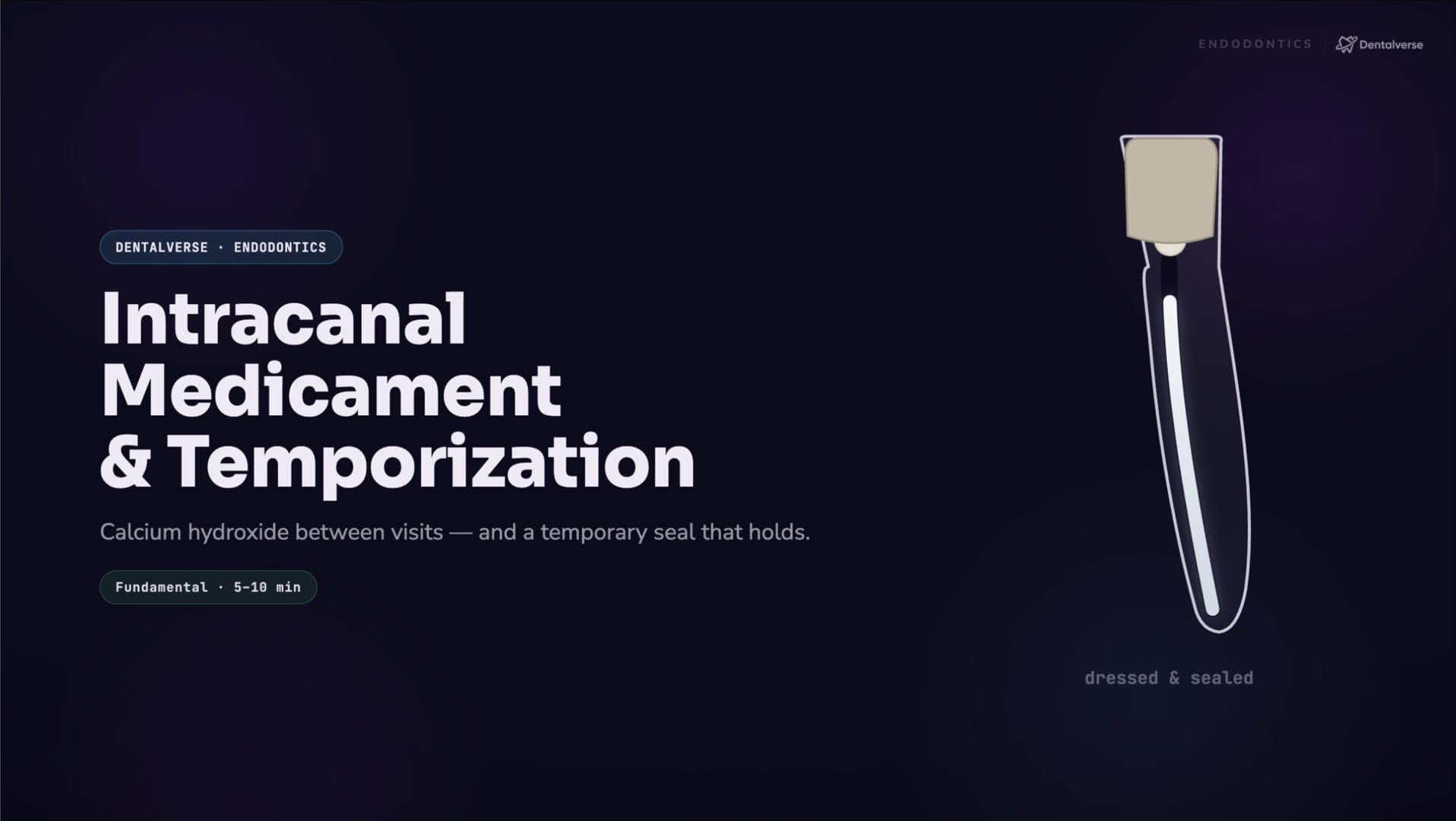
How to Place Calcium Hydroxide Between Root Canal Visits (Without Voids or a Failing Temporary)
Why Ca(OH)₂ is the go-to inter-appointment dressing, how to place a dense full-length fill, and how to temporize so the seal actually holds.
You shaped the canal, irrigated it, and you're not obturating today. What happens in the next two weeks decides whether that appointment counted for anything. The inter-appointment dressing and the temporary seal are a two-part system — and in clinic, students lose marks (and cases) on both halves.
Why the dressing–seal system works (and where it fails)
Think of the intracanal medicament as the part of your treatment that keeps working after the patient leaves the chair. No irrigation protocol clears every microbe, so the dressing keeps pressure on whatever survived, neutralizes bacterial toxins still in the canal, and acts as insurance if the temporary leaks before the next visit.
The workhorse is calcium hydroxide — Ca(OH)₂ — and its mechanism is beautifully simple: pH. It releases hydroxyl ions and drives the local pH to around 12.5, an extreme alkalinity that is directly antimicrobial and helps detoxify bacterial endotoxin.
Here's the detail students routinely miss. The AAE names calcium hydroxide the primary choice of intracanal medicament — and specifies it should entirely fill the canal. A blob in the coronal third is not a medicament; it's a gesture. A dense, void-free, full-length fill is genuinely technique-sensitive: it depends on a properly dried canal, controlled delivery, and verifying the paste reached the apical third — each a place where a rushed operator quietly fails.
The second half of the system is just as unforgiving. The AAE is explicit that even with a medicament in place, an interim restoration can still leak — the coronal seal is essential, not optional. The classic failures — a wafer-thin temporary over a fat cotton pellet, an occlusion left high — trace back to skipped checks. Two rules worth memorizing: thickness seals; height dislodges. And one that never bends: never leave the tooth open between appointments — that outdated habit turns the canal into an open door for reinfection. Contain the case; don't vent it.
Key takeaways
- The dressing and the temporary seal succeed or fail together — a perfect Ca(OH)₂ fill under a leaking temporary still fails.
- Calcium hydroxide works through extreme alkalinity (pH ~12.5), but it only earns its effect when it entirely fills the canal.
- Never leave a tooth open between appointments; contain the case with a dressing and a sound, occlusion-checked seal.
Learn the full protocol
The complete walkthrough lives in Dentalverse: the narrated video lesson, the step-by-step protocol with armamentarium and pitfalls, and the night-before prep sheet. Start with the reference page, or start free and study it properly.
This article is a study aid for dental students, not medical advice — always follow your institution's protocols and current clinical guidelines.