Dentalverse
Dentalverse
Explore Features
Tooth Atlas
52 teeth mapped
Drug Reference
27 medications
Anesthesia Guide
11 anesthetic agents
Clinical Procedures
135 step-by-step
Tomorrow's Clinic
Prep sheets & day planner
Medical Conditions
83 conditions
Clinical Thinking
40 case simulations
Clinical Mistakes
105 common errors
Video Library
Curated by specialty
INBDE Prep
3,386 study cards
AI Study Tools
Teach Me, Quiz, Chat
View all features
LibraryPodcastBlogPricingFAQLog inTry Free
All articles
EndodonticsVital Pulp TherapyDeep CariesIndirect Pulp Capping

How to Perform Indirect Pulp Capping Without Exposing the Pulp

Leave a little, seal a lot: how to remove infected dentin, spare the affected layer, and let a deeply carious pulp heal without exposing it.

D
Dr. Saleh Albakri
July 13, 2026
3 min read

Deep caries puts you in a bind: remove every last bit and you risk exposing the pulp, but leave too much and you fear reinfection. Indirect pulp capping (IPT) resolves that tension with one principle — leave a little, seal a lot. Done well, it lets a vital but deeply carious tooth heal itself instead of heading straight to root canal treatment.

Why the seal, not the drill, does the healing

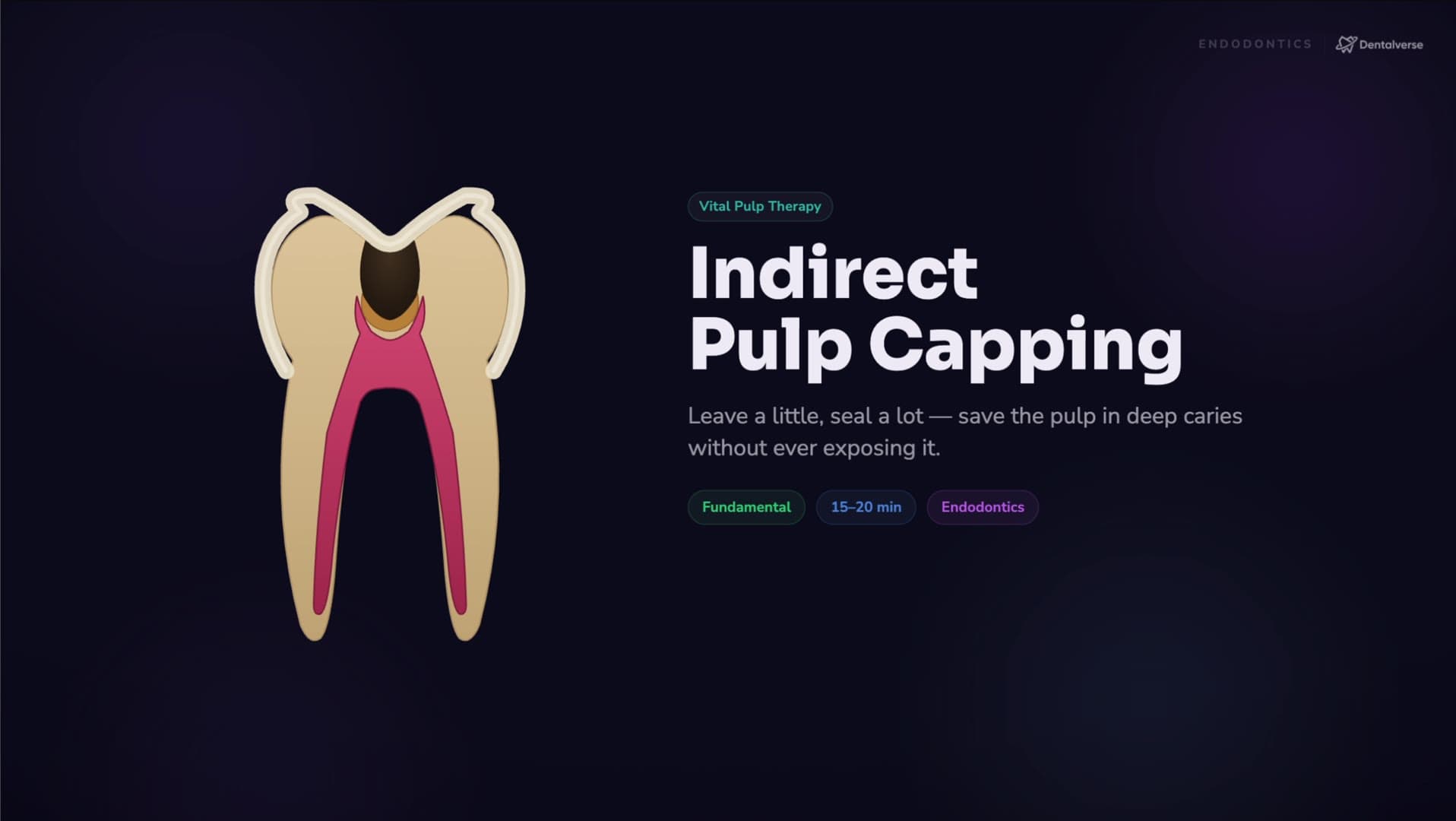
Everything in IPT turns on one distinction, tracing back to Fusayama's two-layer theory of carious dentin. The outer, infected layer is soft, wet, and bacteria-laden, with denatured collagen that can never remineralize — that layer goes, all of it. The inner, affected layer is firm, carries few bacteria, and keeps its collagen intact; sealed away from bacteria, it can remineralize. That layer stays over the pulp.

So the mental model is not "keep going until it's all hard." It is hard dentin at the margins — where the seal lives — and soft affected dentin deliberately spared at the pulpal floor: a low-value scrape over the pulp traded for a high-value seal. Under that seal, residual bacteria are starved, the lesion arrests, the affected dentin remineralizes, and odontoblasts lay down reparative dentin over the pulp horn. The tooth heals through biology, not carpentry.

Why is it tricky? Because most failures are decided before the bur touches the tooth. Only a vital pulp — at worst in caries-related reversible pulpitis — in a restorable, sealable tooth qualifies; spontaneous or lingering pain, swelling, or apical changes take you out of vital pulp therapy entirely. The excavation endpoint is tactile, not visual — color alone will fool you. And contemporary guidance (ESE 2019) favors one-step selective removal because every re-entry is another chance to expose the pulp. Even then, success is a biological bet confirmed on recall over months, never on the day.

Key takeaways

  • Case selection is king. Only a vital, restorable tooth with — at worst — reversible pulpitis has earned an attempt at IPT.
  • Leave affected, remove infected. The two-layer distinction, judged by hardness rather than color, is the entire clinical decision.
  • The seal does the healing. A biocompatible liner under a leak-proof restoration starves residual bacteria and lets reparative dentin form.

Learn the full protocol

The complete walkthrough lives inside Dentalverse: the narrated video lesson, the step-by-step protocol with armamentarium and pitfalls, and the night-before prep sheet. Start with [the reference page](/explore/procedures/indirect-pulp-capping), then [start free](/signup) to unlock the lesson.

This article is a study aid for dental students, not medical advice; always follow your institution's protocols and your supervising clinician's guidance.

Inside the app

Put this into practice inside Dentalverse

Every concept in this article is backed by interactive reference material, AI tools, and practice questions.

Tooth Atlas
Tooth #14
Maxillary Left 1st Molar
Roots3 (MB, DB, P)
Canals3–4 (MB2 common)
InnervationPSA nerve
BlockPSA injection
Tooth Atlas→
Drug Reference
AntibioticPenicillin
Amoxicillin
First-line for odontogenic infections
Adult dose
500 mg PO every 8 hours
Prophylaxis (AHA)
2 g PO, 30–60 min pre-op
Contraindication
Penicillin allergy
Drug Reference→
Clinical Case
HR 80
45 min
$520
Turn 2 of 4
A 62-year-old presents with severe pain on tooth #30. BP 148/92. Takes warfarin for AFib.
Next step
Order INR before extraction
Extract immediately
Refer to physician
Clinical Cases→
INBDE Prep
PharmacologyCard 47 / 120
Question
What is the max recommended dose of 2% lidocaine with 1:100,000 epi in a healthy adult?
A3.0 mg/kg
B4.4 mg/kg
C7.0 mg/kg
D10 mg/kg
INBDE Prep→
Procedures
Operative
Class II Composite
8 steps · 30-45 min
1
Anesthesia + isolation
2
Caries removal
3
Matrix + wedge placement
4
Etch + bond
5
Incremental fill
Procedures→
AI Study Chat
When do I prescribe antibiotic prophylaxis for a prosthetic joint patient?
Dentalverse AI
Per the 2015 ADA guideline, routine antibiotic prophylaxis is generally not recommended for prosthetic joint patients. Consult the orthopedic surgeon for high-risk individuals.
ADA 2015JADA
AI Chat→

Continue reading

Ectopic Eruption of the First Permanent Molar: When to Observe, Intercept, or Refer

3 min read

Why You Never Replant a Primary Tooth (and Always Try to Save a Permanent One)

6 min read

How to Extract a Primary Tooth Safely — and Stop the Bleeding Before the Child Goes Home

3 min read

Ready to study smarter?

Sign up free and start studying smarter.

Try Free
Dentalverse

Your dental school companion from Day 1 through graduation. Built for dental students.

Features
Tooth AtlasDrug ReferenceAnesthesia GuideClinical ProceduresTomorrow's ClinicMedical ConditionsClinical ThinkingClinical MistakesVideo LibraryINBDE PrepAI Study Tools
Resources
Explore the LibraryPodcastBlogFAQContact Us
Legal
Privacy PolicyTerms of ServiceRefund PolicyCookie PolicyDisclaimerAI Use PolicyCommunity GuidelinesCopyright

© 2026 Denverse Ltd (Company No. 17146294). All rights reserved.

Educational platform only. Content is not medical or dental advice.