Dentalverse
Dentalverse
Explore Features
Tooth Atlas
52 teeth mapped
Drug Reference
27 medications
Anesthesia Guide
11 anesthetic agents
Clinical Procedures
135 step-by-step
Tomorrow's Clinic
Prep sheets & day planner
Medical Conditions
83 conditions
Clinical Thinking
40 case simulations
Clinical Mistakes
105 common errors
Video Library
Curated by specialty
INBDE Prep
3,386 study cards
AI Study Tools
Teach Me, Quiz, Chat
View all features
LibraryPodcastBlogPricingFAQLog inTry Free
All articles
Endodonticsprocedural errorsperforation repairroot canal

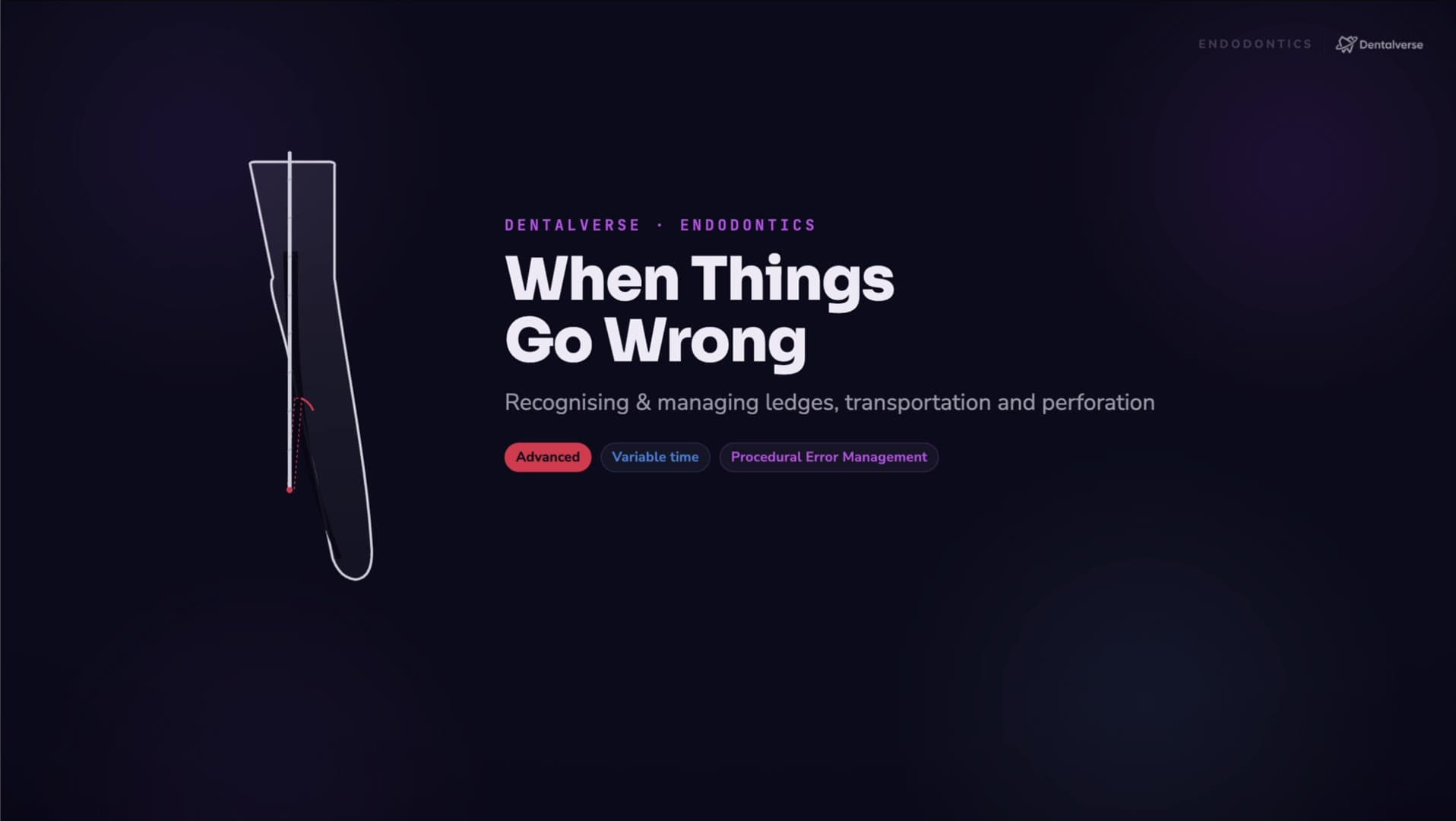
How to Manage a Ledge, Canal Transportation, or Perforation During Root Canal Treatment

A senior-mentor guide to the three big endodontic errors: bypassing ledges, recovering canal transportation, and sealing perforations with MTA.

D
Dr. Saleh Albakri
July 13, 2026
3 min read

Every endodontist you admire has ledged a canal, transported an apex, or watched blood well up from a spot where blood should not be. What separates them from the student who loses the tooth is not luck — it is recognition speed and a calm, ordered response. Here is the mental model behind the three classic errors.

Why these errors threaten the tooth — and the mindset that saves it

Every procedural error harms the tooth through one of two mechanisms: it blocks you from reaching and disinfecting the apical canal system, or it opens a new communication with the periodontium — a leak that did not exist before. Every management step exists to undo one of those two problems, which is why the accident itself is not the failure; failing to recognise and manage it is.

Recognition is mostly tactile and pattern-based. A ledge announces itself through repetition — a file stopping at the same point every time after you had previously reached length. Transportation shows as a sudden loss of working length and the radiographic zip and elbow of a canal pulled off its axis. A perforation declares itself with bleeding from a point that does not match canal anatomy, a drop into space, or an apex locator reading "apex" far too early.

The trap in all three is the same instinct: to keep cutting. Enlarging at a ledge deepens the false path; aggressive shaping after transportation worsens the deviation; instrumenting through a perforation invites contamination. The expert response runs the other way: stop, recover the original pathway, seal early. That is also why MTA-class bioceramics dominate perforation repair — they seal well, they are biocompatible, and they set in moisture and blood, the environment a real defect gives you. Prognosis favours speed, small defects, and apical over cervical locations — and honest referral is the right choice, not the weak one.

Key takeaways

  • Procedural errors reduce healing probability through two mechanisms only: blocked apical disinfection and new leaks into the periodontium.
  • Each error has a recognisable signature — the repeating stop, the zip and elbow, bleeding that does not match anatomy — and recognition speed drives prognosis.
  • The instinct to keep cutting is what turns a small error into a lost tooth; the expert reflex is stop, recover, seal early.

Learn the full protocol

The complete walkthrough lives in Dentalverse: the narrated video lesson, the step-by-step management protocol with armamentarium and pitfalls, and the night-before prep sheet. Start with [the reference page](/explore/procedures/ledge-transportation-perforation-repair), or [start free](/signup) to study it properly.

This article is a study aid for dental students, not medical advice — always follow your institution's protocols and current clinical guidelines.

Inside the app

Put this into practice inside Dentalverse

Every concept in this article is backed by interactive reference material, AI tools, and practice questions.

Tooth Atlas
Tooth #14
Maxillary Left 1st Molar
Roots3 (MB, DB, P)
Canals3–4 (MB2 common)
InnervationPSA nerve
BlockPSA injection
Tooth Atlas→
Drug Reference
AntibioticPenicillin
Amoxicillin
First-line for odontogenic infections
Adult dose
500 mg PO every 8 hours
Prophylaxis (AHA)
2 g PO, 30–60 min pre-op
Contraindication
Penicillin allergy
Drug Reference→
Clinical Case
HR 80
45 min
$520
Turn 2 of 4
A 62-year-old presents with severe pain on tooth #30. BP 148/92. Takes warfarin for AFib.
Next step
Order INR before extraction
Extract immediately
Refer to physician
Clinical Cases→
INBDE Prep
PharmacologyCard 47 / 120
Question
What is the max recommended dose of 2% lidocaine with 1:100,000 epi in a healthy adult?
A3.0 mg/kg
B4.4 mg/kg
C7.0 mg/kg
D10 mg/kg
INBDE Prep→
Procedures
Operative
Class II Composite
8 steps · 30-45 min
1
Anesthesia + isolation
2
Caries removal
3
Matrix + wedge placement
4
Etch + bond
5
Incremental fill
Procedures→
AI Study Chat
When do I prescribe antibiotic prophylaxis for a prosthetic joint patient?
Dentalverse AI
Per the 2015 ADA guideline, routine antibiotic prophylaxis is generally not recommended for prosthetic joint patients. Consult the orthopedic surgeon for high-risk individuals.
ADA 2015JADA
AI Chat→

Continue reading

Ectopic Eruption of the First Permanent Molar: When to Observe, Intercept, or Refer

3 min read

Why You Never Replant a Primary Tooth (and Always Try to Save a Permanent One)

6 min read

How to Extract a Primary Tooth Safely — and Stop the Bleeding Before the Child Goes Home

3 min read

Ready to study smarter?

Sign up free and start studying smarter.

Try Free
Dentalverse

Your dental school companion from Day 1 through graduation. Built for dental students.

Features
Tooth AtlasDrug ReferenceAnesthesia GuideClinical ProceduresTomorrow's ClinicMedical ConditionsClinical ThinkingClinical MistakesVideo LibraryINBDE PrepAI Study Tools
Resources
Explore the LibraryPodcastBlogFAQContact Us
Legal
Privacy PolicyTerms of ServiceRefund PolicyCookie PolicyDisclaimerAI Use PolicyCommunity GuidelinesCopyright

© 2026 Denverse Ltd (Company No. 17146294). All rights reserved.

Educational platform only. Content is not medical or dental advice.