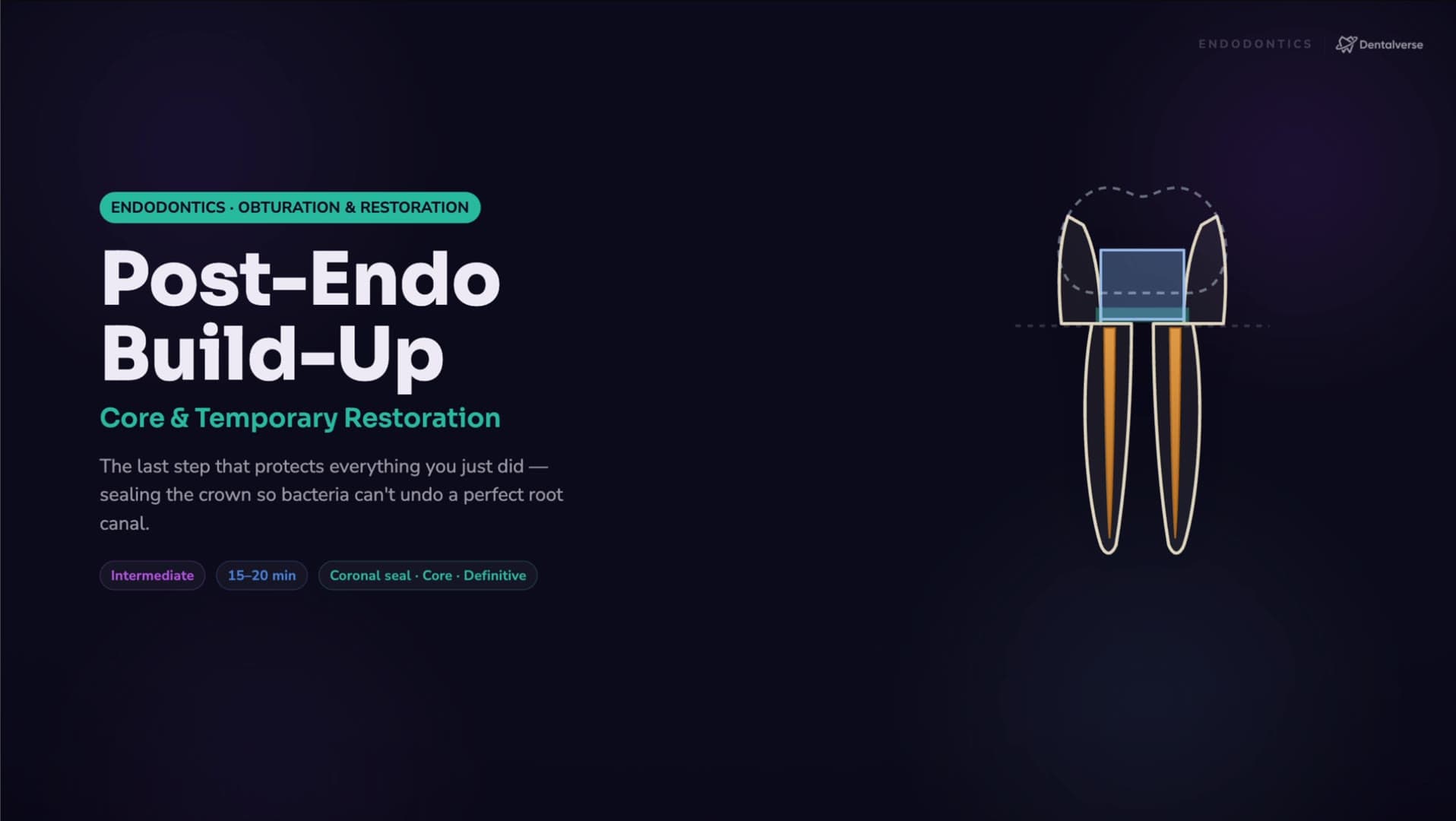
How to Do a Post-Endo Core Build-Up (and Place a Temporary That Actually Seals)
Why the coronal seal decides root canal success, the 7-step core build-up, and how to place a temporary that won't leak — a guide for dental students.
You can obturate a canal beautifully and still lose the tooth. If saliva and bacteria leak past a poor coronal restoration, the whole system re-contaminates from above — and the outcome data says the restoration on top matters as much as the fill underneath. Here is how to think about the step that protects everything you just did.
Why the coronal seal decides whether your root canal succeeds
Once the canals are filled, the crown of the tooth is still an open door. Microbes leaking coronally can re-infect the root canal system no matter how dense the obturation looks radiographically. The systematic review by Gillen et al. (2011, Journal of Endodontics) found that coronal restoration quality significantly affects outcomes — in some analyses, as much as the root filling itself. The root filling is not the finish line; the seal on top of it is.
Picture the failure mode: a flawless fill, a loose cotton pellet, a thin smear of temporary material, and a patient who disappears for three months. Coronal leakage, re-contamination, failure. The traps are the quiet ones — residual sealer on the pulp-chamber walls sabotages the bond, and an unchecked occlusion fractures brittle, root-filled teeth. Nothing looks wrong on the day; everything fails later.
The mental model has two branches. First: is the tooth even restorable? That judgment weighs remaining structure — above all the ferrule, the collar of sound dentin that lets a crown grip the tooth rather than lever off under load — plus cracks, caries, and periodontal support. Second: can the definitive restoration go in today? If not, that is legitimate, but it carries obligations — a temporary with real bulk and marginal adaptation (the oversized pellet under a thin sliver of material is the classic leak), and a definitive appointment actually booked. Temporize deliberately — and never let the temporary quietly become the permanent restoration.
Key takeaways
- The coronal seal is a major determinant of endodontic success — sometimes as decisive as the root filling itself (Gillen et al., 2011).
- Restorability comes before restoration: ferrule, cracks, caries, and periodontal support decide the plan.
- A temporary is a deliberate decision with a booked endpoint, not a default — thin material and long delays invite coronal leakage.
Learn the full protocol
The complete walkthrough is inside Dentalverse: the narrated video lesson, the step-by-step protocol with armamentarium and pitfalls, and the night-before prep sheet. Start with the reference page, then start free to work through the full lesson.
This article is a study aid for dental students, not medical advice — always follow your institution's protocols and current clinical guidelines.