Dentalverse
Dentalverse
Explore Features
Tooth Atlas
52 teeth mapped
Drug Reference
27 medications
Anesthesia Guide
11 anesthetic agents
Clinical Procedures
135 step-by-step
Tomorrow's Clinic
Prep sheets & day planner
Medical Conditions
83 conditions
Clinical Thinking
40 case simulations
Clinical Mistakes
105 common errors
Video Library
Curated by specialty
INBDE Prep
3,386 study cards
AI Study Tools
Teach Me, Quiz, Chat
View all features
LibraryPodcastBlogPricingFAQLog inTry Free
All articles
EndodonticsApexificationMTA apical plugOpen apex

How to Close an Open Apex on a Dead Tooth: The MTA Apical Plug, Step by Step

A necrotic immature tooth can't close its own root. See why an open apex extrudes filling and how the MTA apical plug builds the barrier it needs.

D
Dr. Saleh Albakri
July 13, 2026
3 min read

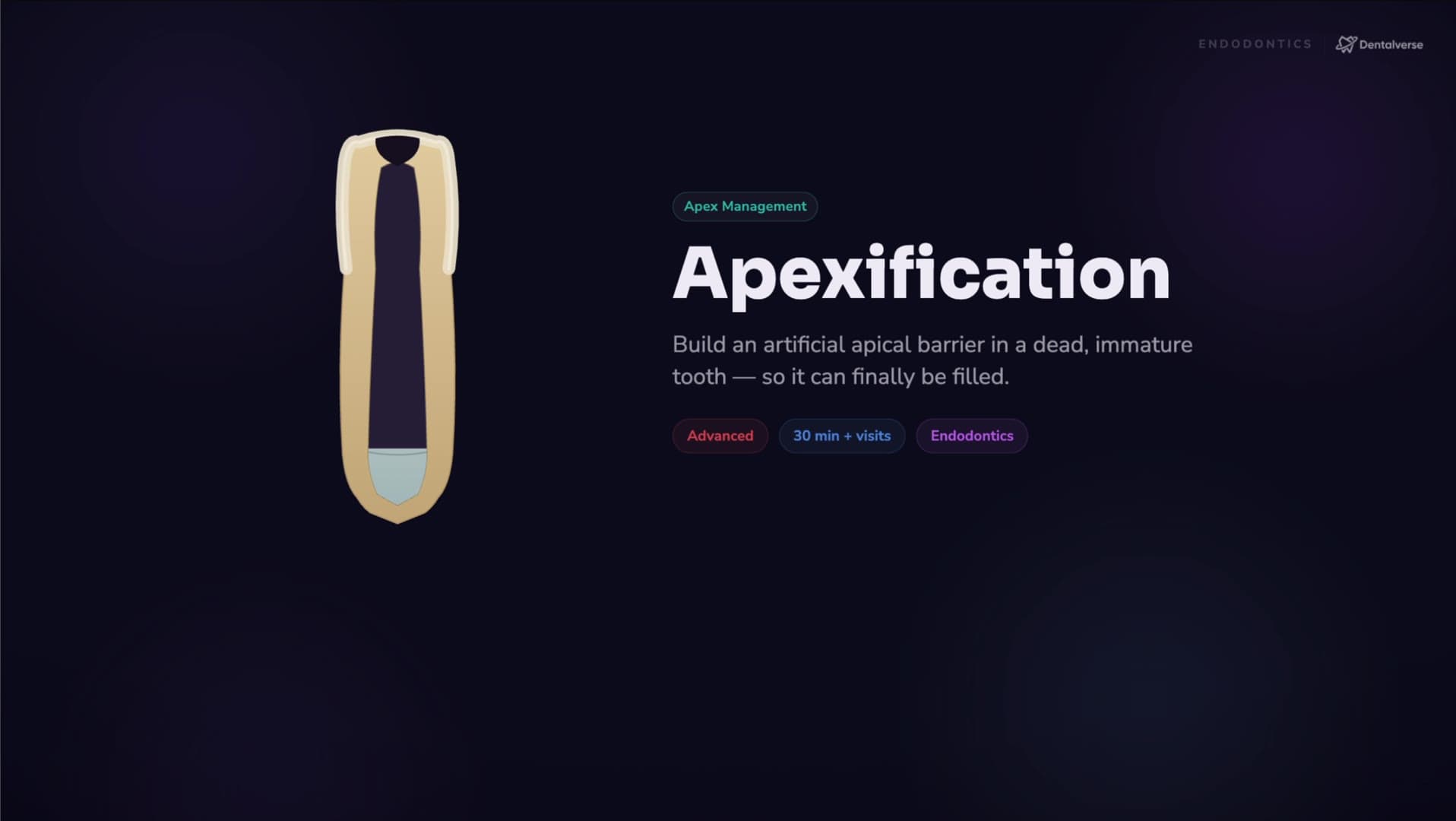
A young premolar takes a hit on the playground, the pulp dies, and root development stops cold. Now you have a wide, flaring apex and a necrotic canal — and if you reach for gutta-percha, it will squirt straight out the end. Apexification is how you manufacture the apical stop the root never grew, so the tooth can finally be filled.

Why an open apex needs a manufactured barrier

Everything in this procedure exists to solve one geometric problem. A mature root narrows to a tight apical constriction, and gutta-percha packs firmly against that natural stop. An immature open apex is the opposite — wide, divergent, offering no resistance — so filling material simply extrudes into the periapical tissues. Before you can obturate, you have to build a root-end barrier the fill can seat against. That is apexification: building an apical barrier in an immature permanent tooth whose pulp is non-vital.

The concept sharpens against its mirror image. In apexogenesis, the pulp is still alive; keep it alive and the tooth finishes the job itself. In apexification, the pulp is dead and can build nothing, so you place the barrier for it. Same open apex on the radiograph — a living pulp closes it, a dead one needs you.

The field has also moved on how the barrier gets built. The classic multi-visit calcium hydroxide method stimulates a calcified barrier over many months, but modern guidance discourages it — it drags treatment out and can weaken already-thin dentin. The preferred approach is a single-visit MTA or bioceramic apical plug: an immediate artificial barrier, backfilled the same visit. What makes these cases tricky is everything around the plug — fragile walls that punish instrumentation, an apex with no stop against extrusion, and regenerative endodontics as the parallel option, the only one that can continue root development.

Key takeaways

  • A dead pulp can't finish building its root, so apexification manufactures the apical stop that makes obturation possible.
  • Apexification and apexogenesis hinge on one question: apexogenesis is what a living pulp does; apexification is what you do when it can't.
  • The single-visit MTA or bioceramic plug replaced months of calcium hydroxide; treatment time, compliance, and thin dentin all argue against waiting.

Learn the full protocol

The complete walkthrough lives inside Dentalverse: the narrated video lesson, the full step-by-step apical-plug protocol with armamentarium and pitfalls, and the night-before prep sheet. Start with [the reference page](/explore/procedures/apexification) for structured indications and success criteria, then [start free](/signup) to unlock the lesson.

This article is a study aid for dental students, not medical advice. Always follow your institution's protocols and your supervising clinician's guidance.

Inside the app

Put this into practice inside Dentalverse

Every concept in this article is backed by interactive reference material, AI tools, and practice questions.

Tooth Atlas
Tooth #14
Maxillary Left 1st Molar
Roots3 (MB, DB, P)
Canals3–4 (MB2 common)
InnervationPSA nerve
BlockPSA injection
Tooth Atlas→
Drug Reference
AntibioticPenicillin
Amoxicillin
First-line for odontogenic infections
Adult dose
500 mg PO every 8 hours
Prophylaxis (AHA)
2 g PO, 30–60 min pre-op
Contraindication
Penicillin allergy
Drug Reference→
Clinical Case
HR 80
45 min
$520
Turn 2 of 4
A 62-year-old presents with severe pain on tooth #30. BP 148/92. Takes warfarin for AFib.
Next step
Order INR before extraction
Extract immediately
Refer to physician
Clinical Cases→
INBDE Prep
PharmacologyCard 47 / 120
Question
What is the max recommended dose of 2% lidocaine with 1:100,000 epi in a healthy adult?
A3.0 mg/kg
B4.4 mg/kg
C7.0 mg/kg
D10 mg/kg
INBDE Prep→
Procedures
Operative
Class II Composite
8 steps · 30-45 min
1
Anesthesia + isolation
2
Caries removal
3
Matrix + wedge placement
4
Etch + bond
5
Incremental fill
Procedures→
AI Study Chat
When do I prescribe antibiotic prophylaxis for a prosthetic joint patient?
Dentalverse AI
Per the 2015 ADA guideline, routine antibiotic prophylaxis is generally not recommended for prosthetic joint patients. Consult the orthopedic surgeon for high-risk individuals.
ADA 2015JADA
AI Chat→

Continue reading

Ectopic Eruption of the First Permanent Molar: When to Observe, Intercept, or Refer

3 min read

Why You Never Replant a Primary Tooth (and Always Try to Save a Permanent One)

6 min read

How to Extract a Primary Tooth Safely — and Stop the Bleeding Before the Child Goes Home

3 min read

Ready to study smarter?

Sign up free and start studying smarter.

Try Free
Dentalverse

Your dental school companion from Day 1 through graduation. Built for dental students.

Features
Tooth AtlasDrug ReferenceAnesthesia GuideClinical ProceduresTomorrow's ClinicMedical ConditionsClinical ThinkingClinical MistakesVideo LibraryINBDE PrepAI Study Tools
Resources
Explore the LibraryPodcastBlogFAQContact Us
Legal
Privacy PolicyTerms of ServiceRefund PolicyCookie PolicyDisclaimerAI Use PolicyCommunity GuidelinesCopyright

© 2026 Denverse Ltd (Company No. 17146294). All rights reserved.

Educational platform only. Content is not medical or dental advice.