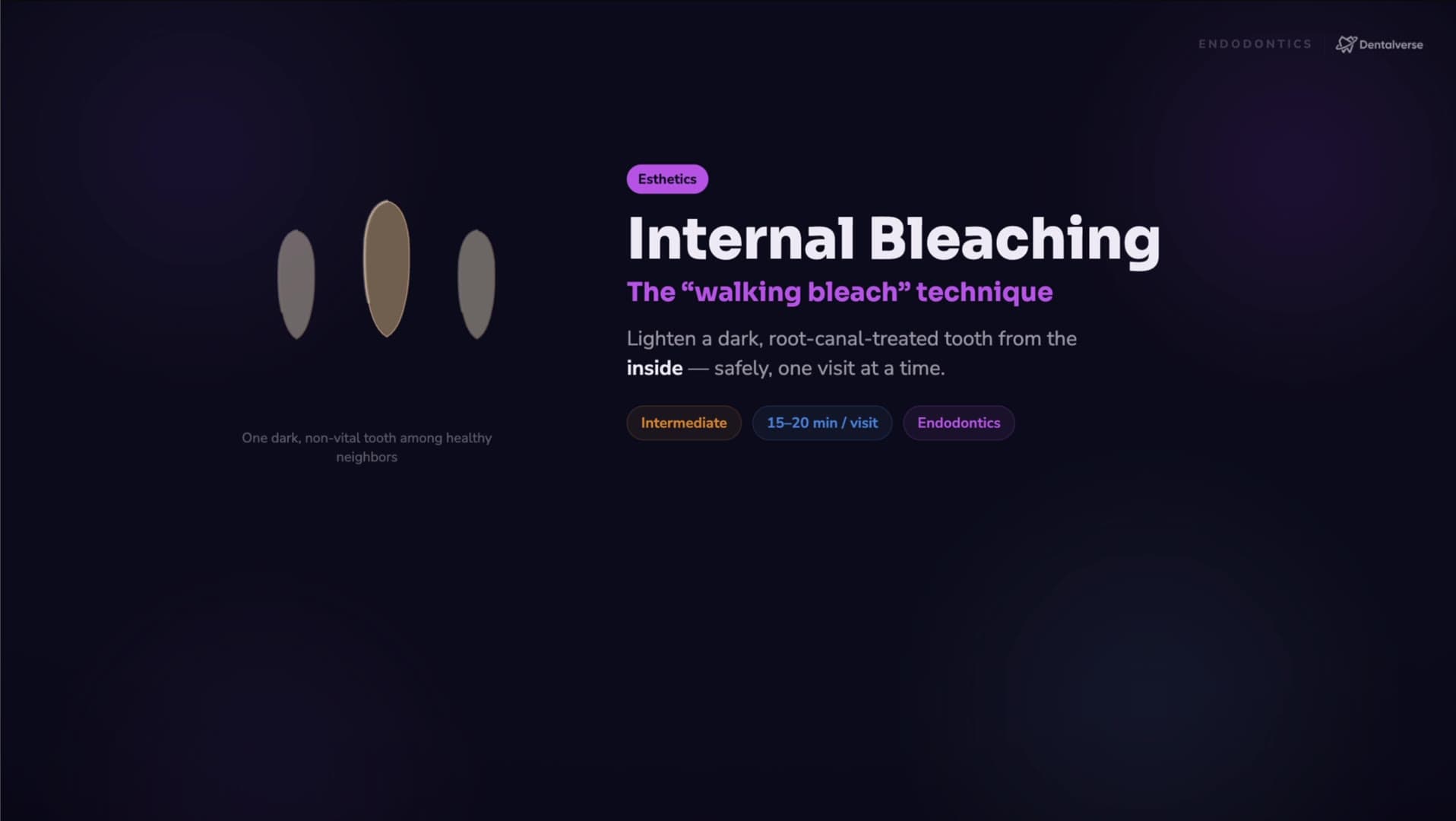
How to Bleach a Non-Vital Tooth From the Inside: The Walking Bleach Technique, Step by Step
Walking bleach for dark non-vital teeth, step by step: case selection, the cervical barrier rule, safe agents, and how to avoid cervical resorption.
A single dark incisor in an otherwise bright smile is one of the most common esthetic complaints after dental trauma — and one of the easiest to over-treat. Before anyone reaches for a crown or veneer, there's a far more conservative option: lightening the tooth from within its own pulp chamber. Here's the walking bleach technique — what it is, who it's for, and the one safety step you're never allowed to skip.
The idea — and the one complication that shapes everything
Walking bleach is an intracoronal technique for a discolored, endodontically treated tooth. Because the pulp is gone, the empty chamber becomes your working space: a bleaching paste is sealed inside under a temporary restoration and left to work between appointments — the patient walks around with the bleach inside, hence the name. It targets intrinsic stain — darkness locked inside the dentin after pulp necrosis, intrapulpal hemorrhage, or old endodontic materials — not the surface stain that trays and in-office gels treat.
Case selection is strict. The tooth must be adequately root-filled, intrinsically discolored, and restorable with a good coronal seal. The rule worth memorizing: if the seal is doubtful, retreat before you bleach.
One complication shapes the entire modern protocol: external cervical resorption, associated with the older heat-based (thermocatalytic) approach and with 30–35% hydrogen peroxide diffusing out through the cervical region. Modern walking bleach is a risk-control system built against that single failure mode — no heat, safer chemistry (sodium perborate with water by default), and a physical cervical barrier that blocks the diffusion pathway. Understand why the barrier exists and the protocol stops being a checklist. But the execution — where the barrier sits, how the paste is refreshed, when to stop — is where cases are won or lost.
Key takeaways
- Walking bleach is the conservative first option for a single dark, non-vital tooth: it treats intrinsic stain from inside the chamber instead of covering the tooth.
- External cervical resorption is the complication the whole protocol exists to prevent; no heat, milder agents, and the cervical barrier all trace back to it.
- Case selection decides the result — only an adequately root-filled, restorable tooth qualifies; a doubtful seal means retreatment first.
Learn the full protocol
The complete walkthrough lives in Dentalverse: the narrated video lesson, the step-by-step protocol with armamentarium and pitfalls, and the night-before prep sheet. Start with the reference page, then start free to unlock the lesson.
This article is a study aid, not medical advice — always follow your institution's protocols and your supervising clinician's guidance.