Dentalverse
Dentalverse
Explore Features
Tooth Atlas
52 teeth mapped
Drug Reference
27 medications
Anesthesia Guide
11 anesthetic agents
Clinical Procedures
135 step-by-step
Tomorrow's Clinic
Prep sheets & day planner
Medical Conditions
83 conditions
Clinical Thinking
40 case simulations
Clinical Mistakes
105 common errors
Video Library
Curated by specialty
INBDE Prep
3,386 study cards
AI Study Tools
Teach Me, Quiz, Chat
View all features
LibraryPodcastBlogPricingFAQLog inTry Free
All articles
Pediatric Dentistryfluoride varnishcaries preventionpreventive dentistry

How to Apply Fluoride Varnish in Children (And Get the Frequency Right)

The 22,600 ppm number, the Band-Aid allergy screen, a thin targeted film, and risk-based recall — fluoride varnish in kids, done right in 5 minutes.

D
Dr. Saleh Albakri
July 13, 2026
3 min read

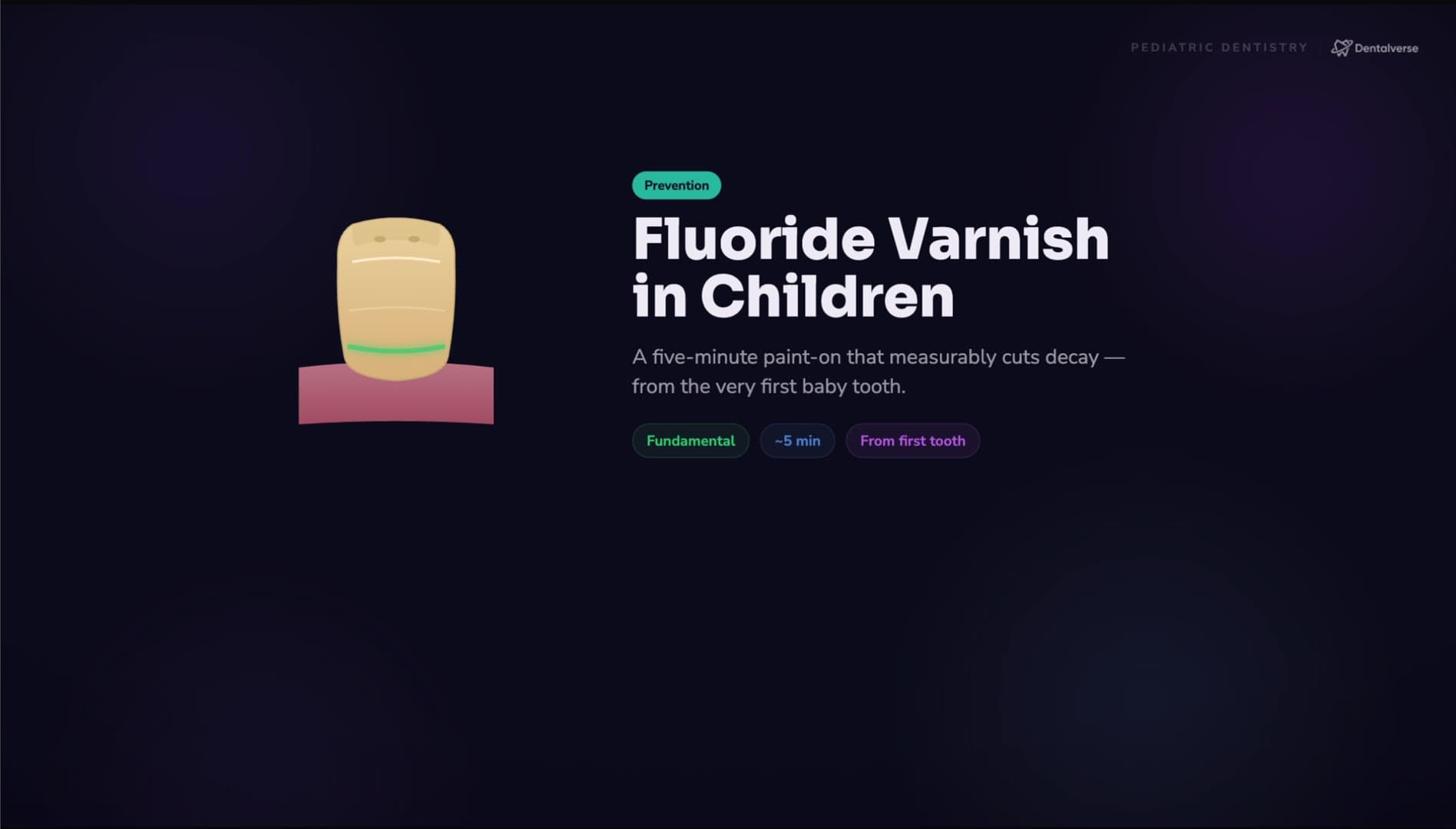
Fluoride varnish is the highest-value five minutes in pediatric dentistry: a quick paint-on that measurably reduces caries, usable from the very first erupting tooth. Yet students routinely fumble the same three things — the concentration, the contraindication screen, and how often to reapply. Here's the mental model that keeps all three straight.

Why varnish is a risk decision, not a painting task

Start with the one equation written three ways. The standard product is 5% sodium fluoride varnish — the same material labeled as 2.26% fluoride ion or 22,600 ppm, depending on whether you're reading AAPD, ADA, or European sources. Recognizing all three as one material is the foundation. Per AAPD, that material is effective in both primary and permanent teeth, with strong evidence in higher-risk children under five.

The second shift in thinking: you're not treating a tooth, you're treating a child's caries trajectory. Indication is risk-based — active caries, white-spot lesions, or risk factors like frequent sugar exposures and orthodontic appliances all point the same way. And because the indication is risk, the frequency is too. There is no single "correct" reapplication number; AAPD, ADA, and EAPD guidance converge on one behavior: higher risk, more frequent applications — and the risk level you assign at the exam drives the recall plan.

The trickiness isn't in the painting — it's in what happens before it. A short contraindication screen (including a clever proxy question about adhesive-bandage rashes that stands in for a colophony allergy history) separates a safe five-minute procedure from an incident report. And the technique has one governing principle: varnish works by staying on the tooth. It's the most moisture-tolerant fluoride vehicle we have — exactly why it succeeds on a wriggly toddler — but only as a thin, targeted film where caries actually starts, not globbed on thick.

Key takeaways

  • One material, three labels: 5% NaF, 2.26% fluoride, and 22,600 ppm are the same varnish — recognize the equivalence on sight.
  • Frequency isn't a memorized number; the child's caries-risk level sets the recall dial, and higher risk turns it up.
  • The mechanism is retention: a thin, moisture-tolerant film that stays on the tooth — and the pre-application screen matters as much as the painting itself.

Learn the full protocol

The complete walkthrough lives in Dentalverse: the narrated video lesson, the step-by-step protocol with armamentarium and pitfalls, and the night-before prep sheet. Start with [the reference page](/explore/procedures/fluoride-varnish-in-children), and [start free](/signup) to unlock it.

This article is a study aid for dental students, not medical advice — always follow your institution's protocols and the product's instructions for use.

Inside the app

Put this into practice inside Dentalverse

Every concept in this article is backed by interactive reference material, AI tools, and practice questions.

Tooth Atlas
Tooth #14
Maxillary Left 1st Molar
Roots3 (MB, DB, P)
Canals3–4 (MB2 common)
InnervationPSA nerve
BlockPSA injection
Tooth Atlas→
Drug Reference
AntibioticPenicillin
Amoxicillin
First-line for odontogenic infections
Adult dose
500 mg PO every 8 hours
Prophylaxis (AHA)
2 g PO, 30–60 min pre-op
Contraindication
Penicillin allergy
Drug Reference→
Clinical Case
HR 80
45 min
$520
Turn 2 of 4
A 62-year-old presents with severe pain on tooth #30. BP 148/92. Takes warfarin for AFib.
Next step
Order INR before extraction
Extract immediately
Refer to physician
Clinical Cases→
INBDE Prep
PharmacologyCard 47 / 120
Question
What is the max recommended dose of 2% lidocaine with 1:100,000 epi in a healthy adult?
A3.0 mg/kg
B4.4 mg/kg
C7.0 mg/kg
D10 mg/kg
INBDE Prep→
Procedures
Operative
Class II Composite
8 steps · 30-45 min
1
Anesthesia + isolation
2
Caries removal
3
Matrix + wedge placement
4
Etch + bond
5
Incremental fill
Procedures→
AI Study Chat
When do I prescribe antibiotic prophylaxis for a prosthetic joint patient?
Dentalverse AI
Per the 2015 ADA guideline, routine antibiotic prophylaxis is generally not recommended for prosthetic joint patients. Consult the orthopedic surgeon for high-risk individuals.
ADA 2015JADA
AI Chat→

Continue reading

Ectopic Eruption of the First Permanent Molar: When to Observe, Intercept, or Refer

3 min read

Why You Never Replant a Primary Tooth (and Always Try to Save a Permanent One)

6 min read

How to Extract a Primary Tooth Safely — and Stop the Bleeding Before the Child Goes Home

3 min read

Ready to study smarter?

Sign up free and start studying smarter.

Try Free
Dentalverse

Your dental school companion from Day 1 through graduation. Built for dental students.

Features
Tooth AtlasDrug ReferenceAnesthesia GuideClinical ProceduresTomorrow's ClinicMedical ConditionsClinical ThinkingClinical MistakesVideo LibraryINBDE PrepAI Study Tools
Resources
Explore the LibraryPodcastBlogFAQContact Us
Legal
Privacy PolicyTerms of ServiceRefund PolicyCookie PolicyDisclaimerAI Use PolicyCommunity GuidelinesCopyright

© 2026 Denverse Ltd (Company No. 17146294). All rights reserved.

Educational platform only. Content is not medical or dental advice.