ART vs ITR: What's the Difference, and How Do You Actually Place One Without a Drill?
ITR is timing, ART is setting — same hands, different intention. Learn the no-drill excavation, GIC finger-press, and the follow-up plan step by step.
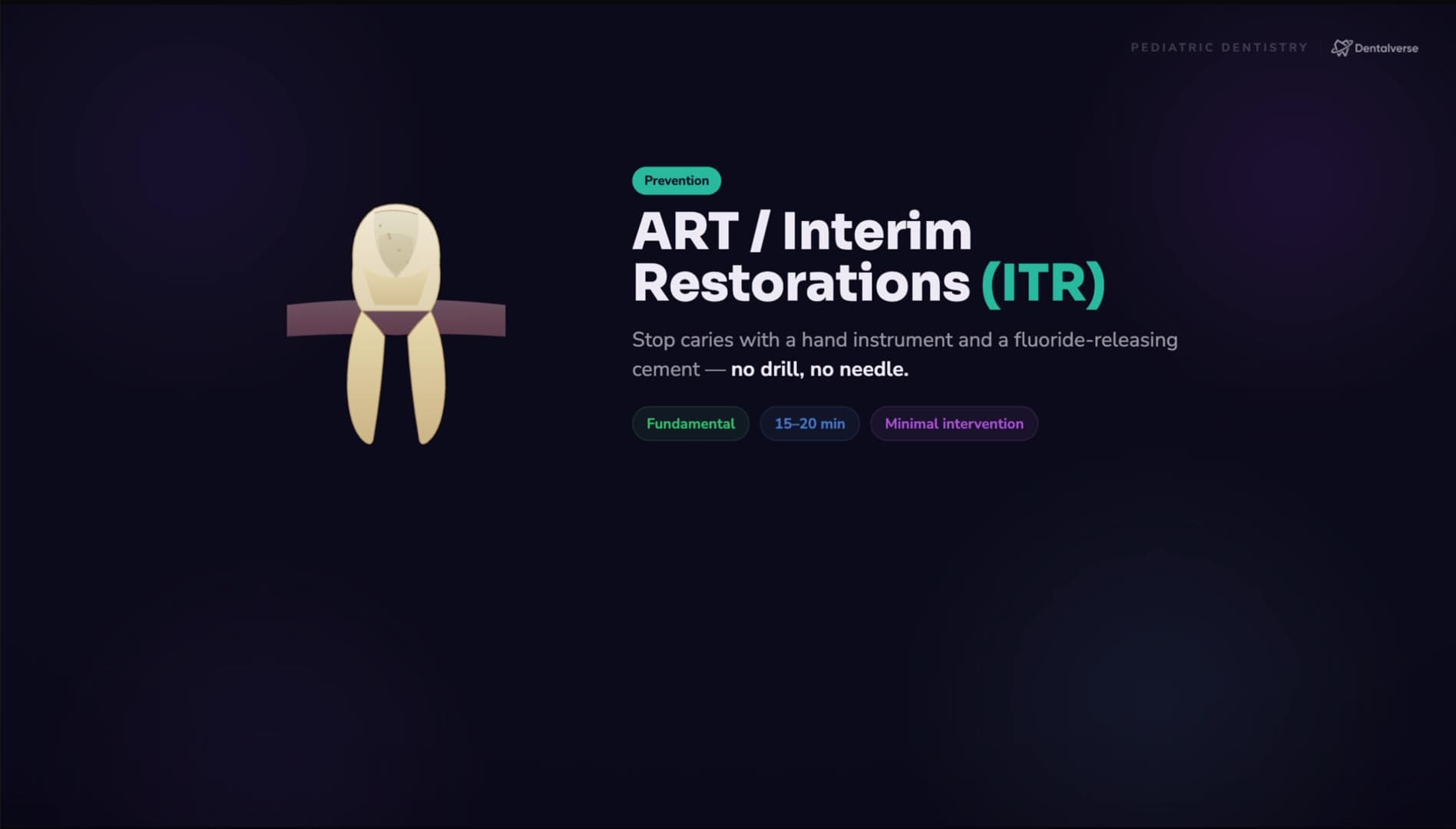
You can arrest a carious lesion with a spoon excavator and a fluoride-releasing cement — no handpiece, no local anesthetic, fifteen to twenty minutes chairside. That is the whole promise of ART and ITR, and it is why examiners love asking about them. The catch: students routinely blur the two terms and butcher the excavation, so let's fix both.
Same hands, different intention
At the operative level, ART (atraumatic restorative treatment) and ITR (interim therapeutic restoration) are nearly identical: hand-instrument caries removal followed by a glass-ionomer restoration. What separates them is intention. ITR, per the AAPD, is about timing — interim stabilization within a comprehensive plan, placed because a conventional preparation is not feasible today (a very young or uncooperative child, for instance) and replaced with definitive care later. ART is about setting — a minimal-intervention technique for places where conventional care is limited, like field clinics, and it may serve as definitive treatment. Say it back until it sticks: the hands do the same thing; ITR is timing, ART is setting.
Glass ionomer is chosen because of that context, not in spite of it. It bonds chemically without an etch-and-bond step, releases fluoride right at the margin of a caries-active patient, and tolerates a damp field. Tolerant is not immune, though — loss of seal is the failure mode, hence the two hard stops: suspected pulpal involvement, and any field where a seal cannot be achieved. The excavation is where beginners go wrong: it is a mindset, not a checklist — the periphery serves the seal, the deep floor spares the pulp, and knowing when to stop digging is the entire skill. And the restoration only succeeds inside a plan — interim means come back, with the caries drivers controlled.
Key takeaways
- ART and ITR are the same technique with different intention: ITR = timing (interim, within a plan), ART = setting (minimal intervention where care is limited).
- The seal is everything — glass ionomer earns its place through chemical adhesion, fluoride release, and moisture tolerance, but pulpal involvement or an unachievable seal rules the technique out.
- Placement is half the treatment: success depends on follow-up, caries control, and replacing interim work when feasible.
Learn the full protocol
The complete walkthrough is inside Dentalverse: the narrated video lesson, the step-by-step protocol with armamentarium and pitfalls, and the night-before prep sheet. Begin with the reference page, then start free to unlock the lesson.
This article is a study aid for dental students, not medical advice — always follow your institution's protocols and your supervising clinician's guidance.